

Excerpt:
Titanium Grade 6 (Ti-5Al-2.5Sn, UNS R54520) technical guide from Hangbo Alloy (Shanghai Hangbo Alloy Group, nickel-alloy.com). The most widely used fully-alpha titanium alloy - 828 MPa minimum tensile in the annealed condition, weldable and metallurgically stable, with notch ductility at cryogenic temperatures. Covers ASTM B348/B265 supply, AMS 4926/4906/4907 callouts, chemistry, elevated-temperature and cryogenic behavior, and the ELI derivative.
Titanium Grade 6 (Ti-5Al-2.5Sn / UNS R54520) — Plate, Sheet and Bar Technical Guide | Hangbo Alloy
Technical Bulletin for Aerospace, Cryogenic, and High-Temperature Process Engineering
Introduction
Most engineers know titanium through the α+β workhorse Ti-6Al-4V, but a distinct branch of the titanium family exists precisely where Ti-6Al-4V is not the right answer: the fully alpha (α) alloys. Titanium Grade 6 — Ti-5Al-2.5Sn, UNS R54520, W.Nr. 3.7115 — is the most widely used α alloy in the titanium system and the reference material for applications that demand three properties at once: a stable, weldable single-phase microstructure; retention of strength at elevated temperature where β-rich alloys soften or over-age; and predictable, notch-ductile behavior at cryogenic temperatures where most metals become brittle. No other common titanium grade balances those three requirements as cleanly.
The alloy earns its position from its two deliberate additions. Aluminum, the classic α stabilizer, dissolves strongly in the hexagonal close-packed α lattice and raises both the strength and the beta transus. Tin, the second addition, provides solid-solution strengthening with minimal penalty to ductility and, unlike many elements, does not destabilize the α phase or form embrittling compounds in the amounts used. The result is a moderate-strength alloy — minimum 828 MPa tensile / 793 MPa yield in the annealed condition — that cannot be damaged by heat treatment, because there is no β phase retained to transform and no aging reaction to misfire. Grade 6 is supplied in the annealed condition and stays metallurgically stable through welding, hot forming, and decades of service at temperature.
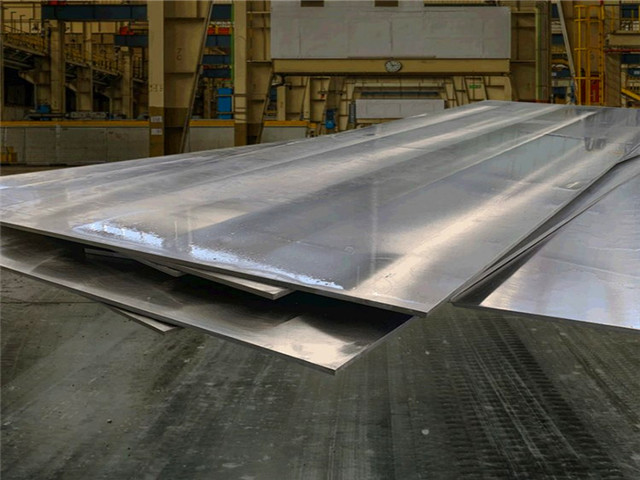
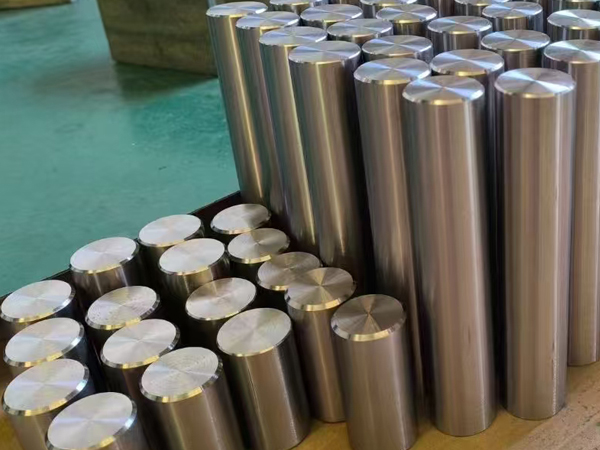
Shanghai Hangbo Alloy Group (nickel-alloy.com) supplies Titanium Grade 6 in plate, sheet, strip, bar, billet, and forgings, certified to ASTM B348 and B265 as applicable, with EN 10204 3.1 mill certification, 100% PMI verification, and full heat traceability. This guide covers the chemistry, metallurgy, mechanical and physical envelope, elevated-temperature and cryogenic behavior, welding practice, and applications of Ti-5Al-2.5Sn — including the extra-low-interstitial (ELI) derivative that serves the deepest cryogenic duty.
Chemical Composition
The composition limits below are the acceptance baseline for Grade 6 mill products supplied by Hangbo Alloy to ASTM B348 and B265. Titanium is the balance element.
| Element | ASTM Spec Limit (wt %) | Typical Heat Value | Metallurgical Role |
|---|---|---|---|
| Titanium (Ti) | Balance | ~90 | α-phase matrix |
| Aluminum (Al) | 4.0 – 6.0 | 5.0 – 5.8 | Primary α stabilizer and strengthener; raises beta transus |
| Tin (Sn) | 2.0 – 3.0 | 2.2 – 2.8 | Solid-solution strengthener; minimal ductility penalty |
| Iron (Fe) | 0.50 max | 0.05 – 0.20 | Trace; a β stabilizer, kept low to preserve α structure |
| Oxygen (O) | 0.20 max | 0.10 – 0.17 | Interstitial strengthener; critical for cryogenic toughness |
| Carbon (C) | 0.08 max | 0.01 – 0.03 | Interstitial; controlled for ductility |
| Nitrogen (N) | 0.05 max | 0.01 – 0.02 | Interstitial; potent strengthener, embrittles at low temperature if high |
| Hydrogen (H) | 0.015 max | 0.002 – 0.005 | Held low to avoid hydride formation |
| Other elements, each / total | 0.10 / 0.40 max | — | Per governing ASTM specification |
The oxygen line deserves special attention because it separates the two commercial variants of this alloy. Standard Grade 6 permits 0.20% oxygen maximum and serves room-temperature and elevated-temperature duty through about –196 °C. The ELI (extra-low interstitial) variant, designated UNS R54521 and controlled to roughly 0.12% oxygen maximum with correspondingly tight nitrogen and hydrogen limits, was developed specifically for liquid-hydrogen and liquid-helium service, where interstitial atoms are the controlling factor in notch toughness. When your drawing calls out cryogenic service below about –196 °C, specify the ELI grade — Hangbo Alloy supplies both and certifies the interstitial content explicitly on the mill certificate.
Metallurgy: The Fully Alpha Alloy and Its Consequences
Titanium's allotropic transformation — body-centered cubic β stable above the beta transus, hexagonal close-packed α stable below it — is the foundation of the entire titanium alloy system. α+β alloys such as Ti-6Al-4V exploit that transformation to build two-phase microstructures that can be manipulated by heat treatment. Grade 6 deliberately does the opposite: aluminum and tin are both α stabilizers, so at any practical temperature below the beta transus the alloy is single-phase α, and the beta transus itself is pushed upward to approximately 1040 °C — several hundred degrees above the annealing and service envelope.
A fully α microstructure delivers four engineering consequences:
-
No heat-treatment response — and no heat-treatment risk. Grade 6 cannot be strengthened by quench-and-age, and equally cannot be degraded by an incorrect quench. The specified properties are achieved in the annealed condition and are stable.
-
Superior elevated-temperature stability. Because there is no retained β to decompose into embrittling phases and no α₂ ordering at normal service temperatures, Grade 6 retains its strength and ductility after long exposure at temperature. It is the standard titanium choice for continuous service to roughly 480 °C, with useful short-term capability higher — territory where Ti-6Al-4V begins to lose margin through microstructural coarsening and where creep resistance of the α lattice earns its keep.
-
Clean, strong welds in the as-welded condition. Welding a single-phase α alloy produces a weld and heat-affected zone that are also α. There is no martensitic transformation, no precipitation of brittle secondary phases on cooling, and therefore no requirement for post-weld heat treatment to restore ductility. Weld joints in Grade 6 develop essentially the annealed parent-metal strength, which is why the alloy is a standard material for welded ducting, vessels, and structural fabrications.
-
Cryogenic toughness. Titanium's HCP α phase has no ductile-to-brittle transition of the ferritic-steel type; what limits titanium at low temperature is interstitial embrittlement — oxygen and nitrogen atoms concentrating strain and promoting cleavage. By keeping interstitials at the ELI level and retaining a fine, equiaxed α structure, Grade 6 ELI maintains high notch toughness down to −253 °C and below, a capability almost unique among structural metals.
The anneal for Grade 6 is typically performed in the 705 – 790 °C range, below the beta transus, producing a fine-grained equiaxed α structure with the specified 828/793 MPa minimums and 10% elongation.
Governing Specifications and Product Forms
Grade 6 is certified by UNS number and ASTM product specification. Aerospace and defense procurement frequently adds AMS and MIL callouts; Hangbo Alloy confirms the applicable specification for each order:
| Product Form | ASTM Specification | Notes / Typical Range Supplied by Hangbo Alloy |
|---|---|---|
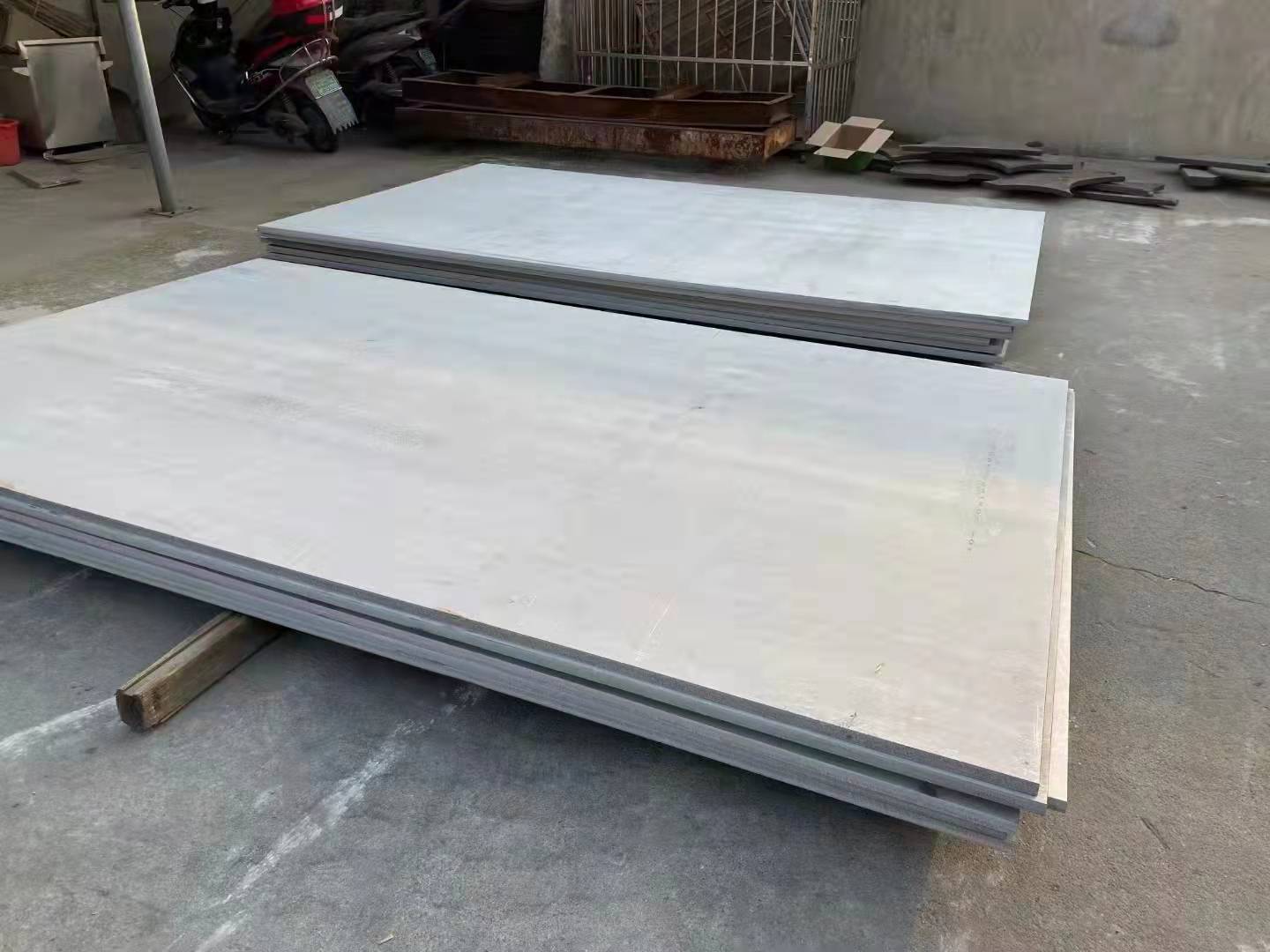
| Plate, sheet, and strip | ASTM B265 | 0.4 – 100 mm thick plate; sheet to 4.75 mm |
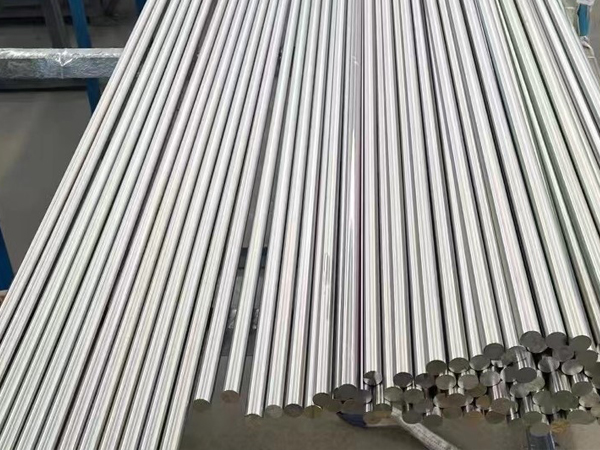
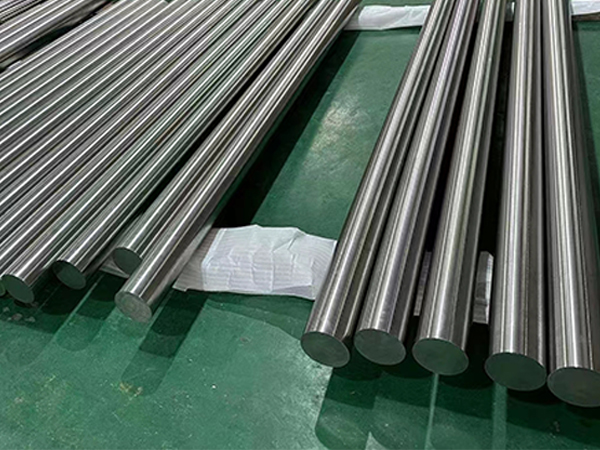
| Bar and billet | ASTM B348 | Round bar Ø 6 – 350 mm; flat and square bar |
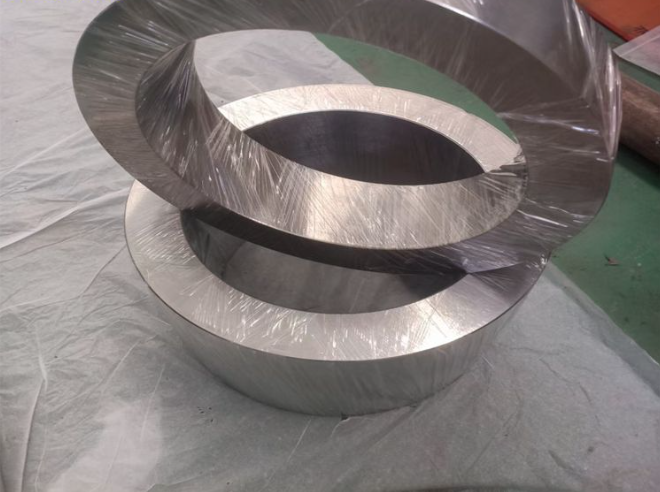
| Forgings | ASTM B381 | Flanges, rings, and custom forgings (Grade F-6) |
| Pipe and tube | ASTM B861 / B862 | Limited — normally a specialty order; confirm availability |
| Aerospace callouts | AMS 4906 (flat), AMS 4926 (bar/forging); ELI per AMS 4907/4929 series | MIL-T-9046 / MIL-T-9047 equivalents common on defense prints |
The standards discipline is identical to the rest of the titanium family: state UNS + product spec together ("Ti-5Al-2.5Sn, UNS R54520, plate per ASTM B265, annealed") so there is no ambiguity between flat-product and bar chemistry, and never accept a certificate that cites only a trade name or a foreign alloy code without its UNS mapping.
Mechanical Properties
Grade 6 minimum tensile requirements (annealed condition) per ASTM B348 and B265 are shown below with representative typical values:
| Property | ASTM Minimum | Typical (Annealed) | Notes |
|---|---|---|---|
| Tensile strength (UTS) | 828 MPa (120 ksi) | 860 – 960 MPa | B348 and B265 tables agree |
| 0.2% yield strength (YS) | 793 MPa (115 ksi) | 820 – 900 MPa | Highest of the common α alloys |
| Elongation in 2 in. (50 mm) | 10% | 12 – 18% | Bar value scales with diameter |
| Reduction of area | — | 25 – 40% | Informational for bar |
| Hardness | — | ~ 280 – 340 HV | Informational; not an acceptance requirement |
| Beta transus | ~1040 °C | — | Well above the service envelope |
Grade 6 occupies an interesting strength position: it is only slightly below the Ti-6Al-4V minimum tensile of 895 MPa, but it achieves that strength without a β phase and without any aging step. For components that are welded, hot-formed, or exposed to sustained temperature, Grade 6 frequently out-performs Grade 5 in stability even where the as-received strengths are comparable.
Elevated-Temperature Stability
The defining high-temperature credential of Grade 6 is retention of properties after long exposure. The fully α structure resists the coarsening and phase decomposition that slowly degrade two-phase alloys in the 300 – 500 °C band, and the alloy's oxidation behavior is the standard titanium story: a protective oxide that allows service to roughly 540 °C in air with design care.
| Condition | Typical 0.2% Yield Strength | Engineering Comment |
|---|---|---|
| Room temperature, annealed | ~830 MPa min | Baseline acceptance value |
| 315 °C (600 °F) | ~ 550 – 600 MPa | Retains roughly 70% of RT yield |
| 425 °C (800 °F) | ~ 480 – 520 MPa | Continuous-service band |
| 480 – 540 °C (900 – 1000 °F) | ~ 400 – 460 MPa | Short-term and creep-limited duty |
For aircraft engine nacelle components, exhaust ducting, and process equipment handling hot oxidizing or mildly reducing media, Grade 6 is frequently specified in preference to age-hardenable alloys precisely because its properties do not drift with thermal history.
Cryogenic Performance
Below about −100 °C most structural metals announce themselves by a transition to brittle fracture. Titanium does not — the α phase retains its deformation modes to very low temperature — and Grade 6 has been the titanium industry's cryogenic workhorse since the earliest liquid-hydrogen programs. The controlling variable is interstitial content, which is why the ELI variant exists:
| Temperature | Standard Grade 6 (O ≤ 0.20%) | Grade 6 ELI (O ≤ 0.12%) |
|---|---|---|
| 20 °C | Full ductility; standard acceptance | Full ductility |
| −196 °C (liquid nitrogen, 77 K) | Good strength and ductility | Excellent notch toughness |
| −253 °C (liquid hydrogen, 20 K) | Limited by notch sensitivity | Excellent — the design intent |
| −269 °C (liquid helium, 4 K) | Not recommended | Usable with careful design |
Applications include liquid-hydrogen storage vessels and transfer lines, cryogenic pump and valve components, superconducting-magnet structures, and aerospace propellant-system hardware. Because strength actually rises as temperature falls — titanium alloys are stronger at −196 °C than at room temperature — cryogenic vessels in Grade 6 are often weight-competitive despite the alloy's moderate room-temperature strength.
Physical Properties
| Property | Value | Notes |
|---|---|---|
| Density | 4.48 g/cm³ (0.162 lb/in³) | Slightly below CP titanium |
| Melting range | ~1540 – 1650 °C | α alloy solidus/liquidus |
| Beta transus | ~1040 °C (~1900 °F) | Raised by Al; verify for ELI heats |
| Modulus of elasticity | ~110 GPa | RT; rises slightly at cryogenic temperature |
| Coefficient of thermal expansion | ~9.4 × 10⁻⁶ /°C (20 – 100 °C) | Low, steel-like |
| Thermal conductivity | ~8 W/m·K | Low — relevant to heat-balance design |
| Magnetic behavior | Non-magnetic | Useful in cryogenic instrumentation zones |
| Annealing range | 705 – 790 °C | Recrystallization anneal, air cool |
Corrosion Resistance
As an α alloy, Grade 6 behaves electrochemically like CP titanium: the protective TiO₂ film forms and self-repairs identically, giving excellent resistance to seawater, chloride brines, oxidizing acids, wet chlorine, and organic media, and full immunity to chloride stress-corrosion cracking. Two differences from the CP grades deserve note. First, the higher strength of Grade 6 means any design must respect the general titanium principle that strength and localized-corrosion susceptibility rise together — for most chemical service, corrosion resistance remains excellent, but very hot, very concentrated reducing acids remain outside the envelope. Second, Grade 6 is selected for chemical plant mainly when the application also needs its strength, temperature stability, or cryogenic capability — for purely corrosion-driven duty, the CP grades or palladium-bearing grades are usually the economic choice. Hangbo Alloy's application engineers routinely advise on this grade-selection logic.
Fabrication, Welding, and Machining
- Hot forming: Grade 6 hot-forms in the 760 – 980 °C band. Because the alloy is α at all practical forming temperatures, there is no risk of forming-induced phase problems; a final anneal restores the specified envelope after heavy work.
- Cold forming: More limited than the CP grades — the higher yield strength demands greater forming loads and springback allowance. Form at elevated temperature for tight radii.
- Welding: GTAW is the standard process with argon shielding and backing purge. Matching Ti-5Al-2.5Sn filler is used where full joint strength is required; the ELI filler variant is mandatory for ELI base metal in cryogenic service so that weld-metal interstitial content does not govern the joint. Preheat is unnecessary; interpass temperature should be controlled; no post-weld heat treatment is required, though a stress-relief anneal may be specified for complex weldments.
- Machining: Grade 6 is more difficult to machine than CP titanium but considerably easier than Ti-6Al-4V. Sharp tools, rigid setups, positive rake angles, and flood coolant are the fundamentals; avoid dwell and rubbing, which cause work hardening and galling.
- Surface protection: Prevent iron contamination from tooling and fixtures, and pickle or passivate after fabrication where the specification requires. For cryogenic components, cleanliness control is essential to avoid condensed-oxygen ignition hazards in oxygen-service lines.
- Quality verification: Because ELI vs. standard chemistry is a service-defining difference, Hangbo Alloy verifies oxygen, nitrogen, and hydrogen by certified LECO analysis on every heat and states the interstitial values on the EN 10204 3.1 certificate.
Applications Summary
- Aircraft and rocket ducting, engine nacelle components, and exhaust structures requiring weldability plus elevated-temperature stability.
- Liquid-hydrogen and liquid-helium storage vessels, transfer piping, valves, and pump housings (ELI variant).
- Cryogenic pressure vessels and structural supports for superconducting systems and LNG research plant.
- Chemical-process heat exchangers and vessels needing CP-class corrosion resistance at higher strength.
- Marine and offshore components where moderate strength and total seawater reliability are required.
- Instrument housings, bellows, and diaphragm assemblies in temperature-cycling service.
- Aerospace hydraulic and pneumatic fittings where annealed stability beats heat-treated complexity.
Hangbo Alloy Supply Program
| Product Form | Specification | Typical Size Range | Testing / Documentation |
|---|---|---|---|
| Plate / Sheet / Strip | ASTM B265 | 0.4 – 100 mm thick | EN 10204 3.1, PMI, LECO interstitial analysis |
| Bar / Billet | ASTM B348 | Ø 6 – 350 mm | EN 10204 3.1, PMI, ultrasonic on request |
| Forgings | ASTM B381 | Custom | Dye penetrant, dimensional, PMI |
| ELI variant (R54521) | Per ASTM + AMS | All forms | Interstitial values certified on MTC |
Hangbo Alloy segregates standard and ELI heats by UNS, verifies composition by OES/PMI with independent LECO oxygen-nitrogen-hydrogen determination, and supports third-party witness testing (SGS, BV, TÜV) at the Shanghai mill.
Technical FAQ — Titanium Grade 6 (Ti-5Al-2.5Sn / UNS R54520)
1. What does "Grade 6" titanium actually contain?
Grade 6 is the titanium alloy Ti-5Al-2.5Sn: nominally 5% aluminum and 2.5% tin with a 0.20% oxygen ceiling. Aluminum is the α stabilizer and main strengthener; tin provides solid-solution strengthening with little ductility penalty. The fully α structure makes it weldable, thermally stable, and heat-treatment-insensitive.
2. Why is Grade 6 used for cryogenic applications?
The HCP α phase has no ductile-to-brittle transition, so titanium does not embrittle at low temperature the way ferritic steels do. The limit to low-temperature toughness is interstitial content, so the ELI variant — oxygen held near 0.12% maximum — retains excellent notch toughness to −253 °C for liquid-hydrogen service, where almost no other structural metal is usable.
3. Can Grade 6 be heat treated to higher strength?
No. As a fully α alloy it has no β phase to transform and no aging response; it is used in the annealed condition. This is an advantage: there is no heat-treatment step to control, qualify, or risk getting wrong.
4. Does Grade 6 need post-weld heat treatment?
No. Welds and heat-affected zones in a fully α alloy are also α, so weldments develop near-parent-metal properties in the as-welded condition. This is the central fabrication advantage of Grade 6 over α+β alloys such as Ti-6Al-4V, which require careful thermal control and often post-weld treatment to restore ductility.
5. What is the difference between Grade 6 and Grade 6 ELI?
The ELI variant (UNS R54521) holds oxygen, nitrogen, and hydrogen to tighter maximums — oxygen near 0.12% versus 0.20% — sacrificing a small amount of room-temperature strength for dramatically better notch toughness at cryogenic temperatures. Use ELI for service below about −196 °C; standard Grade 6 suffices above that.
6. What is the maximum service temperature of Grade 6?
Continuous service is commonly rated to roughly 480 °C, with useful short-term capability to about 540 °C in air. The fully α structure resists the microstructural coarsening that limits two-phase alloys, so Grade 6 is favored for long-life elevated-temperature components.
7. How strong is Grade 6 compared with Ti-6Al-4V?
Grade 6 specifies minimum 828 MPa tensile and 793 MPa yield — close to Ti-6Al-4V's 895/828 MPa — but achieves it in a single-phase, weld-friendly, heat-treatment-free material. Where as-welded strength, thermal stability, or cryogenic toughness matters more than the last increment of strength, Grade 6 frequently wins the selection.
8. Which ASTM specifications cover Grade 6?
ASTM B265 covers plate, sheet, and strip; ASTM B348 covers bar and billet; forgings are covered by ASTM B381. Aerospace procurement commonly adds AMS 4906/4926 and, for the ELI grade, the AMS 4907/4929 series. Grade 6 is not a standard B338 condenser-tube grade.
9. Is Grade 6 corrosion resistant?
Yes — like all titanium grades it relies on the self-repairing TiO₂ passive film and is excellent in seawater, chlorides, oxidizing acids, and wet chlorine, with immunity to chloride stress-corrosion cracking. Hot concentrated reducing acids and hydrofluoric acid remain outside the envelope.
10. How does Hangbo Alloy document Grade 6 quality?
Every shipment includes an EN 10204 3.1 mill certificate with tested chemistry — aluminum, tin, and the critical interstitials (O, N, H) explicitly stated — plus tensile test results, 100% PMI verification, heat-lot traceability, and, on request, third-party witness testing by SGS, BV, or TÜV. Standard and ELI heats are segregated and identified by UNS.
This page is part of the Titanium Alloy Technical Reference series by Hangbo Alloy (Shanghai Hangbo Alloy Group, nickel-alloy.com). Data presented are typical engineering values compiled from recognized industry sources and are provided for material selection guidance; the governing documents for any purchase are the applicable ASTM/ASME specifications (B348, B265, B381) or AMS callouts and the certified mill test report. Contact Hangbo Alloy for current stock, mill certificates, and application engineering support.